
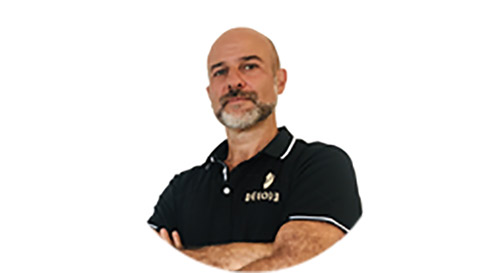
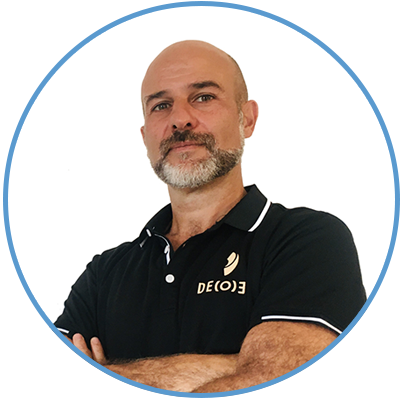
Fabio Marcelloni has devoted his life to Chinese martial arts since 1989, developing a path that brings together martial traditions, internal practices, and the exploration of movement. Specialising in Qi Xing Tang Lang (Seven Star Praying Mantis), in which he holds the rank of 5th Duan Master, and Yang-style Tai Ji Quan, in which he is a certified 4th Duan instructor, he has deepened his studies under Masters Lee Kam Wing, Zhong Lian Bao, and Yang Jun, undertaking numerous training trips to China.
His background also includes Qi Gong, Pilates, Tuina, and Traditional Chinese Medicine. In 2009, he founded Scuola d’Oriente, dedicating himself to teaching students of all ages.
Fabio has known Master Mauro A. D’Angelo for almost thirty years and has witnessed firsthand the evolution of his martial arts research, shaped by his experiences living in China. What has impressed him most is the tangible transformation of Master D’Angelo’s physical qualities, accompanied by an increasingly clear understanding of technical principles and a strong consistency between personal practice and teaching.
When Fabio began his DECODE journey in 2020, he brought with him a wealth of established experience, but also a sense of having reached a plateau in his development. Through the DECODE Method, he discovered a new way to organise knowledge he had previously explored in separate disciplines, gaining a deeper understanding of the relationships between structure, relaxation, multidirectional force, and martial application.
Particularly significant was the discovery of practical tools for exploring the release of unnecessary tension and developing physical qualities through progressive exercises whose effects could be directly experienced and verified.
Today, Fabio teaches DECODE programmes at the national headquarters in Rome and at other locations throughout the Lazio region, while also contributing to the training of new teachers.
For Fabio, DECODE is, above all, “home”: a community in which tradition remains alive through shared practice. In his teaching, he prioritises attentive listening, the observation of bodily tension, and precise corrections, adapting the learning progression to individual characteristics so that each student can gradually recognise and independently develop their own physical qualities.